Black Girl
Drama
Storyline
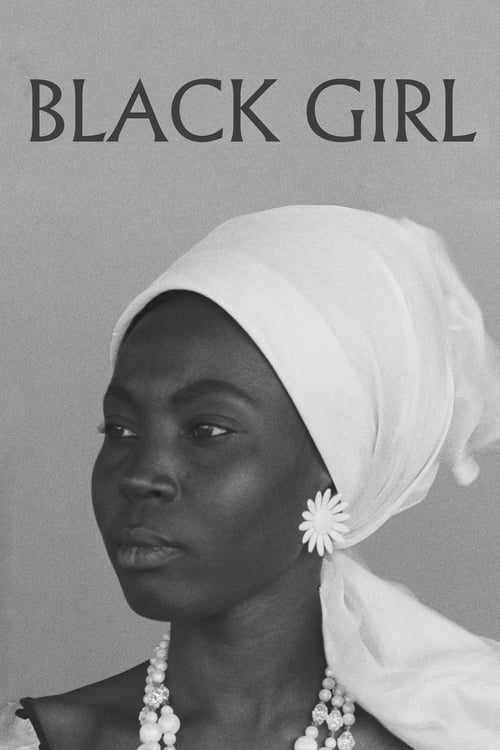
Eager to find a better life abroad, a Senegalese woman becomes a mere governess to a family in southern France, suffering from discrimination and marginalization.

Community Reviews
No community reviews yet.
Reviews from the Web
"In 1966, Senegalese author Ousmane Sembene was among the first Black Africans to shoot a feature film with <i>La Noire de...</i> ("Black Girl"). It deals with the plight of Diouana (Mbissine Thérèse Diop), a Senegalese girl who is hired on as a nanny by a French expat family in Dakar. Initially she is elated to have work, and moreover, work for the country's white elites. After the family returns to France and takes Diouana with her, she finds herself nearly a prisoner, as what should have been an ordinary job with some dignity to it becomes menial drudgery far beyond the initial agreement. Though the plot is a straightforward drama, Sembene also lends the film a metaphoric dimension to confront the enduring legacy of colonialism in the newly independent Senegal, the desire of some Africans for revenge against their erstwhile colonial rulers, as well as political tensions within Africa's ostensibly representative democracies. These elements are, however, so subtle that many viewers without a knowledge of the immediate post-colonial era may miss them. Yet with its 55-minute running time that awkwardly falls between a short and a typical feature, <i>La Noire de...</i> does feel slight. It is shot at a level of quality comparable to any French film of this era (some awkward jump cuts and bad dubbing aside), but it can be seen as a mere tech demo for the more ample, ambitious films that African directors would go on to make in subsequent years."
Read full review →"_Black Girl_ (1966) is a bad movie. I didn’t like it. I know, I know… I’m going to be bashed by others by accusing me of being a racist and/or a sexist and worse yet, claim that I am in favor of domestic slavery, because I am a white male. That is **NOT** so! And no, don’t give me the whole “a good movie doesn’t have to enjoyable” nonsense, because that’s inherently contradictory. There is **NO** difference between a movie you don’t like and a “bad” movie because they pretty much mean the same thing. Hell, I’m sure some people, both black and white, and male and female, thought the movie was bad too, even awful for some, back then. I understand the movie is not exactly designed to be “enjoyed” but nevertheless I will call it “bad” and stop watching it anyway. Yes, racism is bad, yes, sexism is bad, yes, domestic slavery is bad, yes, suicide is bad, it should be informed to the general public because these are important issues, but making narrative fiction on those topics might not be the best answer. Yes, there are those who claim _Black Girl_ is a good movie, but there are others who claim the opposite, like me, even if I’m in the minority. I get it that my opinion regarding movies, especially ones of a frankly negative nature, are hard pressed to be labeled “valid”. Also, it is a fact I don’t exactly like this flick but it is my opinion that it is bad. This is the closest to being the difference between a movie I dislike and a bad movie. But they are interconnected in that disliking something shows that I feel and think something is bad. One thing that is beyond me is when movies “glamorize” everything, which they almost always do, even if not directly intended. There is nothing inherently wrong with glamorizing visual elements especially when dealing with pleasant situations but when it is tied to life-and-death situations, this gets morally problematic. Now, when I say “glamorize”, I do not mean “to make something appear happy and cheerful”, but rather “to make awe-inspiring, posh and elegant”. As a filmmaker myself, I take caution to how I make my own movies and try to find my happy medium. A good movie **MUST** be a movie you like and wish to watch again later. I watched this movie twice for god’s sake, and the story still (kind of) confuses me. I refuse to apologize for badmouthing a film because it’s an inanimate object; it doesn’t have feelings and thoughts. And I won’t apologize to any butthurt cinephiles who try to prove me wrong, which they can’t. And no, this movie is **NOT** an “essential film” of the 1960s or today. It is chaotic and annoying garbage. You can call me a racist, you can call me a sexist, you can call me an advocate of domestic slavery, you can call me insensitive and ignorant, you can even call me a cold heartless monster if you like, but that is not going to change my apparently offensive attitude. I won’t tolerate any easily offended people in my life. I’ve been bullied and tormented before but I’m not going to commit suicide just like the primary character in the flick did, although I can understand the racism she dealt with in her life. Also, art is a matter of choice in that it is tied to your values. I have my values and other have theirs. Art is neither good or bad by itself because “good” and “bad” are relative to one’s or a group’s opinion. Art is not necessarily intended for pleasure although it always can be and it often is, as it should be. Yes, this movie is mainly intended to inform bad things that go on in the world and I know that a lot. If people like to think I’m a racist, a sexist, an advocate for domestic slavery and suicide, and a stone-hearted monster, that’s on them. I know my heart. I’m sorry that some black women have to deal with such harsh pain."
Read full review →Recommended

La Cérémonie
View Movie →
The Help
View Movie →
Two Days, One Night
View Movie →
The Public Woman
View Movie →