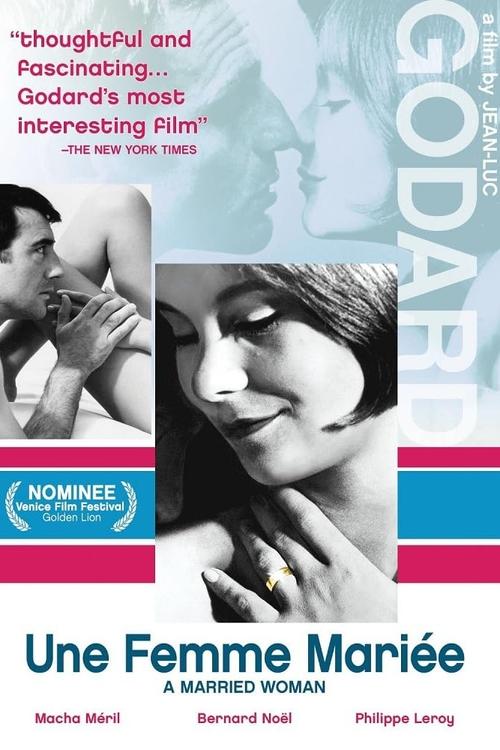
The Married Woman
Drama, Romance
Storyline
A superficial woman finds conflict choosing between her abusive husband and her vain lover.
"She Loves Two Men... She is Married to One!"





Community Reviews
No community reviews yet.
Reviews from the Web
"Jean-Luc Godard's eighth feature film, <i>Une femme mariée</i> (A Married Woman, 1964) is a tale of adultery. As it opens, we meet Charlotte (Macha Meril) at a tryst with her lover Robert (Bernard Noël). Though Robert tries to convince her to divorce her husband, the pilot Pierre (Philippe Leroy), Charlotte's loyalties remain divided. Godard labeled <i>Une femme mariée</i> not a "film" but rather "a collection of fragments from a film shot in 1964". However, this is much less avant-garde disjointed than one might expect. Godard chooses a fragment-based means of storytelling for the moments between Charlotte and her lover, presenting a sequence of brief dialogues between the lovers in rapid succession. Each of these self-encapsulated moments serves as another brick in the wall of what we know about the relationship. Such compressed storytelling manages to distill otherwise ineffable interpersonal dramas and feelings. The framing in the scenes between Charlotte and her lover is remarkable: close-up shots of their faces or limbs against featureless backgrounds. Generally the face of the person speaking is not shown and we hear only the words. But while there had already been myriad such tales of love triangles through the ages, this film offers something fresh by combining it with a critique of 1960s consumer society. The characters pepper their conversation with commercial jingles, parrot whole advertising texts, or recite factoids. In shots of home life, the latest fancy name-brand cleaning products and electronics are placed prominently in the frame. Charlotte and her maid read women's magazines and see whether they live up to the standards of beauty that the media prescribes. The Auschwitz trials were going on at the same time as shooting, and Godard chose to work references to this into the characters' conversations. In this way, he underscores how consumer society emphasizes thinking about the present, buying whatever is called must-have now, and thus discourages self-reflection and critically gazing on the past. The film's message remains perennially fresh, and I think many viewers will enjoy <i>Une femme mariée</i>. Godard would take up the "housewife and consumerism" theme again three years later in <i>2 ou 3 choses que je sais d'elle</i>, where this time the housewife prostitutes herself during the day to buy all the nice things that her husband can't. As a critique of consumerism, that later film is more successful inasmuch as it was shot in colour, and thus shows how commercial brands were using brash designs to draw the eye of shoppers. ("If you can't afford LSD," Godard says in a voiceover there, "buy a colour television.") However, <i>Une femme mariée</i> is not just a rough sketch for the later film, and I'd even call it a better film, inasmuch as it tells a coherent story while the elements of the later one don't entirely come together for me."
Read full review →Recommended
The Secret
View Movie →
Unfaithful
View Movie →
The Man from Elysian Fields
View Movie →
Desire
View Movie →