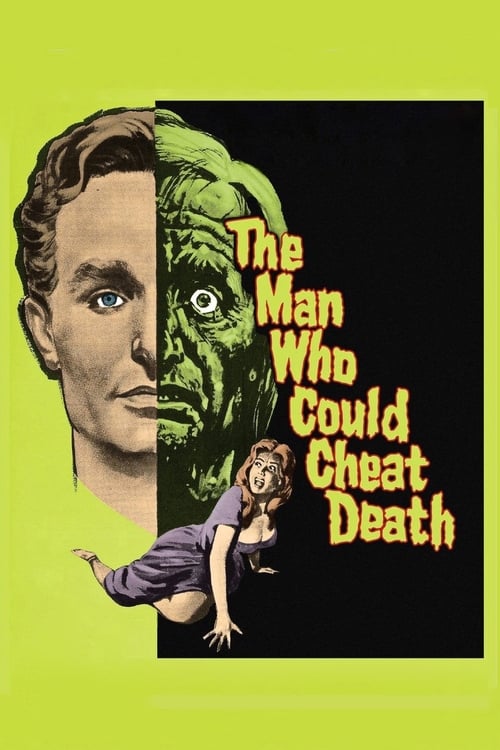
The Man Who Could Cheat Death
Horror, Science Fiction
Storyline
Dr. Bonner plans to live forever through periodic gland transplants from younger, healthier human victims. Bonner looks about 40; he's really 104 years old. But people are starting to get suspicious, and he may not make 200.
"HIS HIDEOUS OBSESSION LED HIM TO COMMIT GHASTLY CRIMES OF PASSION AND VIOLENCE."






Community Reviews
No community reviews yet.
Reviews from the Web
"***Tepid mix of Jack the Ripper and Dr. Jekyll and Mr. Hyde, but still enjoyable*** In 1890, a sculptor in Paris (Anton Diffring) is suspected of something sinister when it’s discovered that he shows up in different city every ten years with missing persons linked to each transition. Hazel Court plays his romantic interest while Christopher Lee rounds out the potential love triangle. "The Man Who Could Cheat Death” (1959) is an obscure Hammer film that should be appreciated by fans of these particular gothic horrors. As my title blurb points out, it meshes elements of Jack the Ripper and Dr. Jekyll and Mr. Hyde with the typical style/sets/locations of Hammer horror. If you favor similar flicks like “The Gorgon” (1964), “Frankenstein Created Woman” (1967) and “Frankenstein Must Be Destroyed” (1969), you’ll probably like this one. Yet it’s the least of these due to unnecessarily puzzling elements concerning the sculptor’s sinister doings. Nevertheless, Diffring is effective in the titular role and it’s nice to see Lee in his younger days playing a noble character, plus redhead Hazel Court is ravishing; and blonde Delphi Lawrence ain’t no slouch. The Paris setting is another distinguishing factor. The role of the sculptor was originally offered to Peter Cushing, but he turned it down. The European release featured a tame scene in which Ms. Court briefly appears topless. The movie runs 1 hour, 23 minutes, and was shot at Bray Studios in Berkshire, England. GRADE: C+"
Read full review →Recommended
Donovan's Brain
View Movie →
Lucy
View Movie →
Self/less
View Movie →
Code 8 Part II
View Movie →