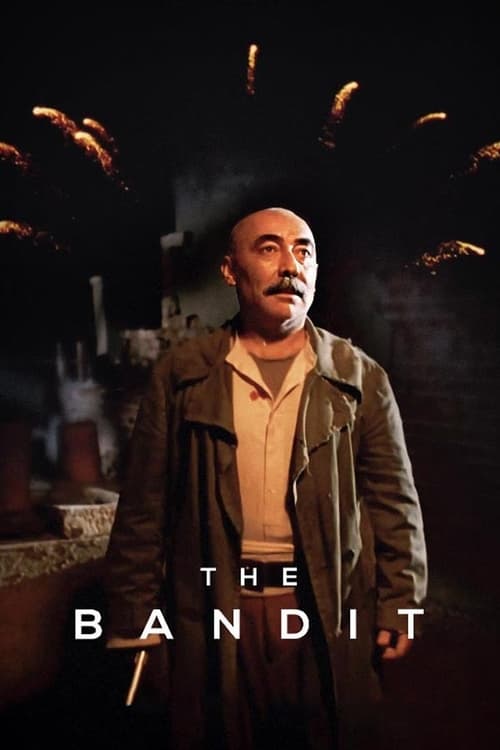
The Bandit
Crime, Drama, Thriller
Storyline
The film tells the story of a group of bandits captured in the Cudi Mountains 35 years ago. All of them have died, either from illness or vendettas; only Baran (Şener Şen) survives. After serving his 35-year sentence, Baran is released from Viranşehir Prison and learns that his birthplace is now submerged under the waters of a dam. Ceren Ana (Zübeyde Erden) tells him about the past. Baran is imprisoned because of the betrayal of his old friend Berfo (Kamran Usluer). Berfo stole the bandits gold, bought his childhood love Keje (Sermin Hürmeriç) from her father, and fled to Istanbul. While Baran is searching for Keje, he encounters a young man named Cumali (Uğur Yücel). These two men find solace in each other to avoid being swept away by the storms of the big city. And in this world where violence, betrayal, passion, boundless love and hatred intertwine, they try to survive.



Community Reviews
No community reviews yet.
Reviews from the Web
"Eskiya is like the Göbekli Tepe, an important, neolithic archaeological discovery in Turkey, unearthed from the depths of cinematic history. It has a value not just because of its age, but because it carries the weight of immutable truth. The digital version’s occasional uneven color grading, perhaps a casualty of its transition from celluloid, does little to dim its luster. This is otherwise a perfect movie, and the reasons why become lucid in retrospect. I normally like to delve into meaning first, but here, there are technical honors at the forefront. The cinematography is a masterclass in using the classic rules of film to turn Anatolia’s expansive beauty into something mythic. Ertunç Şenkay doesn’t just frame the landscape; he lets it breathe, deploying wide lenses to swallow the horizon whole and tight close-ups to reveal a lifetime in the face of his subjects. The land itself is vast and indifferent, or perhaps it’s not indifferent, watching as human dramas unfold beneath its ancient sky, as they always have. This is cinematography that doesn’t merely serve the story, it elevates it like the peak of an Anatolian mountain But the real marvel is Yavuz Turgul’s narrative: a Tolstoyan-sized epic compressed into 120 minutes without losing a nuance. The script is tight, relentless, and utterly unpredictable, moving with the precision of a river that has cut stone deeply over centuries. There’s no wasted motion here, no unnecessary detours. Every subplot, every shift in tone feels inevitable, as if the story has always existed and Turgul simply found the perfect way to tell it. It is rich, multi-faceted, and deep. Two themes rise above the rest, for me at least. The first is the elegy for “honor among thieves,” a concept that feels almost quaint in its nobility. Turgul isn’t just nostalgic; he’s mournful, painting a world where criminals had rules, and betrayal was a huge offense. The film’s real villains aren’t just greedy, they’re modern products of a system where loyalty is a liability and capitalism has rotted everything it touches. Turgul’s political critique is subtle but devastating, a quiet indictment of a world where power corrupts absolutely and money buys everything, or at least the illusion of it. Berfo’s fate is a masterstroke: a man who thought he could purchase affection, only to learn too late that some things cannot be owned. The fact that this was made in 1996—long before the current era of late-stage capitalism’s grotesqueries makes it feel eerily prescient. And then there’s the love. Oh, the LOVE. Eskiya isn’t just a crime saga or a political allegory; it’s a story about the heart in all its forms: eternal, paternal, doomed, deluded. Baran and Keje’s bond is the kind of love that survives time and betrayal, a quiet fire that never quite goes out. Baran and Cumali’s relationship is father-son in the truest sense. It’s not just blood, but choice, the kind of love that is strong and demands sacrifice. Keje and Berfo’s tragic mismatch proves money can’t buy what matters. Emel and Cumali’s doomed romance is a cautionary tale about trust. Emel and Andref’s twisted partnership shows how like attracts like in the worst ways. And then there’s Emel’s mother, another victim of Andref’s manipulations, a reminder that some people leave wreckage wherever they go. At the center of it all is Şener Şen as Baran, a performance of such Buddha-like resolve that it feels sacred. He’s a man who has buried his sins and now seeks redemption, not for reward, but because it’s the only path left that makes sense. His Baran is tragic not because he fails, but because the world isn’t ready for men like him. Sen’s performance begs the question that lingers, heavy and unanswered: Who among us mortals could wear the sandals of Christ? By the end, Eskiya doesn’t just touch you, it transforms you. This is a story that burns like a slow ember after the credits roll. It’s a film that understands the cost of honor, the fragility of love, and the price of trying to be good in a world that rewards the opposite. If you’re a cinephile, this isn’t just a must-see-before-you-die, it’s a revelation."
Read full review →Recommended

King Ivory
View Movie →
Trafficking
View Movie →
Blindfire
View Movie →
Hierarchy
View Movie →