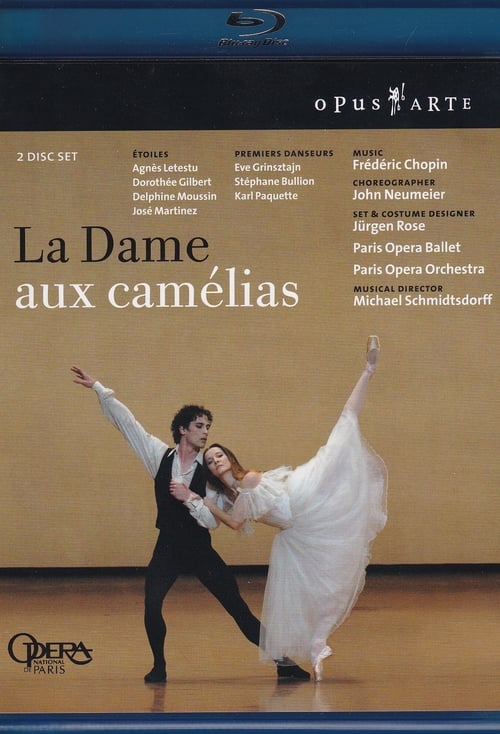
Chopin - La Dame aux camélias
Drama, Romance
Storyline
Ballet in a prologue and three acts based on the novel by Alexandre Dumas fils; music by Chopin. The passionate tale of Marguerite Gautier and Armand Duval unfolds ingeniously through a drama-within-a-drama as they meet at the theatre during a performance of Manon Lescaut. So begin their romantic adventures in Paris, brought to life by Neumeier’s intense and refined choreographic language. Chopin’s ravishing music highlights this exceptional neo-classical ballet, featuring the star dancers of the Paris Opéra Ballet. This lavish production, filmed live at the Palais Garnier in High Definition and full surround sound, is all about love, passion, danger and glorious dancing from one of the best ballet companies in the world. John Neumeier has created a ballet in which emotions go crescendo … Agnes Letestu, the great dramatic heroine, triumphs in this ballet danced to music by Chopin.

Community Reviews
No community reviews yet.
Reviews from the Web
"La Dame aux Camélias, written by Alexandre Dumas fils, was first published in 1848 and was apparently based on the author’s own liaison with the famous courtesan Marie Duplessis. The novel is undoubtedly one of the greatest romances ever written and it has inspired many other artistic works, of which the most famous are possibly Verdi’s opera La Traviata and, more recently, Baz Luhrmann’s movie Moulin Rouge. It follows almost naturally that a choreographer like John Neumeier would have been drawn to create a ballet based on this famous literary masterpiece. Neumeier, though born in 1942 in Milwaukee, Wisconsin, in the United States, has worked for most of his life in Germany where he presently holds the post of “Ballettintendant” of the Hamburg Ballet. After his early dance training in Milwaukee, Neumeier studied ballet both in Copenhagen and at the Royal Ballet School, in London. Interested in other subjects he also obtained a BA in English Literature and Theatre Studies from the Marquette University in Wisconsin. In 1963, the great ballerina Marcia Haydée met him in London; a meeting that eventually led to John Cranko engaging Neumeier to dance at the Stuttgart Ballet. It was here that, under the inspiring hand of Cranko, Neumeier created his first choreographies, with such success that, in 1969, he was appointed director of ballet in Frankfurt where he soon became a sensation. His fame comes not only from his very own interpretations of such celebrated ballets as The Nutcracker, Romeo and Juliet or Daphnis and Chloe but also from his very original creations such as choreographing “non-balletic” pieces, like Mozart’s Requiem, Bach’s St Matthew’s Passion or some of Mahler’s symphonies. He also invented a variety of wonderful narrative ballets, of which the most famous are probably La Dame aux Camélias, his adaptations of works by Shakespeare and Sylvia. In 1973, he became chief choreographer of the Hamburg Ballet and in 1996 its “Intendant” (director), a post he holds to the present day. The music, by Chopin, for La Dame aux Camélias, was not composed specifically as a ballet. In fact, the composer never wrote a ballet or an opera; yet, as one listens to the music while watching the ballet, one has the distinct impression that it was created especially for the stage and to tell the tragic, romantic story of the Lady of the Camellias. This is entirely John Neumeier’s achievement through the clever use of the music, his knowledge of the novel and the dramatically expressive choreography that he created. Neumeier picked a wide variety of pieces by Chopin: some of his preludes, nocturnes, ballads, sonatas and waltzes, as well as some of his music for piano and orchestra; though in essence of course this is nothing new. However, the novelty is Neumeier’s great skill: his ability to join the music in a logical way through the movement of the dancers; his effective use of dramatic elements to tell the story and his respect for the original novel, which is always the one and only source for creating the ballet. The result is a wonderful example of a ballet that tells a story, following in the tradition of John Cranko who successfully revived narrative ballet at a time when contemporary dance had gone abstract and narrative, dramatic ballets appeared to be a thing of the past. John Neumeier created La Dame aux Camélias for the Stuttgart Ballet in 1978. The production in this DVD is a revival of the work by the Paris Opera Ballet and was performed to great critical acclaim at the Palais Garnier in Paris in 2008. It is a delightful production with gorgeous costumes especially designed at the Opera’s own workshops by the talented Jürgen Rose who also designed the sets. The costumes contribute effectively to the telling of the story, as the colours were carefully chosen according to the mood of each scene; a fact cleverly enhanced through the lighting, designed by Rolf Warter. Some might say that the ballet is old-fashioned or that it lacks innovation. On the one hand, this might be true; on the other it is a marvellous example of how narrative ballet can be created effectively to still appear fresh and different. Neumeier’s choreography is extremely difficult to execute; it flows in a pure, classical style, powerful and demanding, yet gentle and expressive with great attention to detail. He creates small gestures clearly linked with parts of the music, which, through repetition at key moments, trigger memories, define the characters and their relationships. For example, Neumeier uses the Largo from Chopin’s Sonata in B minor throughout the ballet. It is associated with the character of Armand who relates the story of his love with the courtesan, Marguerite Gautier, to his father. As in the novel, the story in the ballet is told in flashback and, as Neumeier says, “one cannot invent a step that relates what someone has done yesterday or will do tomorrow” so, to express this effectively, he uses the music in a very intelligent manner; which, explained in his own words, is “...the recurring use of the Largo in different situations, always appearing with Armand, to help us refer to the past; it marks his appearance on stage and triggers his memories ...” The dancers of the Paris Opera Ballet are generally excellent and all the characters are supremely danced, especially the two leads: Agnès Letestu and Stéphane Bullion who are truly outstanding. Ms Letestu makes a very believable Marguerite Gautier, at times coquettish, seductive and vivacious; at others sad, depressed and most of all poignantly moving in the scene with Armand’s father and in the final Act when she is dying alone and in total poverty. Ms Letestu is a graceful, eloquent dancer, with great elegance and charisma. The movements of her arms are wide and delicate; her technique is superb and everything she does on-stage is beautifully stylish, classically harmonious and dramatically expressive, though she is never an exhibitionist and keeps within character from beginning to end. Her performance is well judged, demonstrating Marguerite’s love and ultimate sacrifice in a very moving manner, which, in the scene with Armand’s father, truly touches the heart. The young Stéphane Bullion is a dashing, gorgeous Armand, effectively showing the character’s exuberant passion, making it easy to believe why an experienced woman like Marguerite falls so quickly for such an inexperienced “country-boy” like Armand Duval. Bullion brings a freshness and innocence to the character that causes one to like him and indulge him even in his not so finest moments, as in the famous scene where he insults Marguerite in public, by throwing money at her for their last night of love, not knowing of the great sacrifice that she has made for him. Bullion is dramatically expressive but this would be nothing if not supported by a fabulous technique, easiness and elegance of movements. He executes with athletic precision the extremely difficult lifts of the various pas de deux with Letestu, yet they appear light, with great fluidity and grace. This same lightness is present in the apparent ease with which he jumps and cuts a statuesque figure during the pirouettes, making his whole performance a joy to watch. As in the novel, Neumeier kept “the play within the play”, meaning that the scenes when Marguerite goes to the theatre to watch Abbé Prévost’s Manon Lescaut also appear in the ballet. There is a parallel between the two stories and this is made clearer in the ballet through the dreams of Armand and especially Marguerite where they identify with the characters of the play. Neumeier plausibly creates this effect by having the dancers playing Manon and Des Grieux in distinctively 18th century costumes, dancing with Armand and Marguerite almost as their mirror images. Manon and Des Grieux are excellently brought to life by the young, lovely Delphine Moussin and the fabulous José Martinez respectively. Chopin’s music is wonderfully performed by the orchestra of the Paris Opera, under the solid direction of Michael Schmidtsdorff, and beautifully supports Neumeier’s stylish choreography. The two pianists, Emmanuel Strosser and Frédéric Vaysse-Knitter who perform all the piano pieces, display great sensibility and virtuosity though their interpretation is always suitably understated. They never forget that they are playing to a ballet and not performing Chopin in concert. This fact makes Chopin’s lyrical, romantic music even more effective, perfectly underlying the dancers’ steps, supporting their jumps and highlighting the tender, moving love scenes or the most difficult dance passages. This two-DVD set also contains some extra features: an illustrated synopsis, the cast gallery and, best of all, a documentary Flashback on the Lady of the Camellias made by Stéphane Loison and Reiner E. Moritz, who also wrote the booklet notes. It is an excellent film, containing interesting and informative interviews with the cast, the crew and the Paris Opera Ballet’s director of dance, Brigitte Lefévre. Its most fascinating feature, however, is the conversation with the man himself: John Neumeier. He is an intelligent speaker, clearly expressing his opinions and relating the reasons behind his choreography and his interpretation of the story of La Dame aux Camélias. His love and understanding of the original novel is patent throughout but also the respect he has for it as a work of art and for Chopin’s music. While he talks about the various aspects of the ballet and how he chose the music or why he opted for particular gestures or steps, we see the relevant scenes on the screen, making the enjoyment of his work all the more effective. This production of Neumeier’s ballet La Dame aux Camélias is a glorious achievement, beautifully captured on DVD under the expert direction of Thomas Grimm. It is also a traditional narrative ballet at its best: the romantic, tragic love story is eloquently told, the costumes are gorgeous, the dancers excellent, Chopin’s music is luminous and Neumeier’s choreography is as ever beautifully original yet purely classical in its discreet but stylish elegance. If you like the great classical ballets of the past, like Giselle or Swan Lake, if you love John Cranko’s amazing story ballets, like Onegin or The Taming of the Shrew; then you will adore John Neumeier’s La Dame aux Camélias. I simply loved it and would recommend it whether one is a hopeless romantic or not! Margarida Mota-Bull Music 2nd movement from Concerto no. 1 for Piano and Orchestra in E minor, Op. 11 (1830) Concerto no. 2 for Piano and Orchestra in F minor, Op. 21 (1829-30) Largo from Piano Sonata in B minor, Op. 58 (1844) Prélude no. 2 in A minor, Op. 28 (1838) Prélude no. 15 in D flat major, Op. 28 (1838-9) Prélude no. 17 in A flat major, Op. 28 (1836) Prélude no. 24 in D minor, Op. 28 (1838-9) Valse no. 1 in A flat major from Three Brilliant Waltzes, Op. 34 (1835) Valse no. 3 in F major from Three Brilliant Waltzes, Op. 34 (1838) Nocturne in E minor, Op. 72 (1827-1846) Grande Fantaisie on a Polonaise for Piano and Orchestra in A major, Op. 13 (1828) Andante Spianato and Grande Polonaise Brillante for Piano and Orchestra, Op. 22 (1830-1) Ballade no. 1 in G minor, Op. 23 (1835-6) Read more: http://www.musicweb-international.com/classrev/2009/Sept09/Dame_Camelias_oa1008d.htm#ixzz2YbG0SX00"
Read full review →Recommended
The Red Shoes
View Movie →
High Strung
View Movie →
Center Stage: Turn It Up
View Movie →
Not Easily Broken
View Movie →